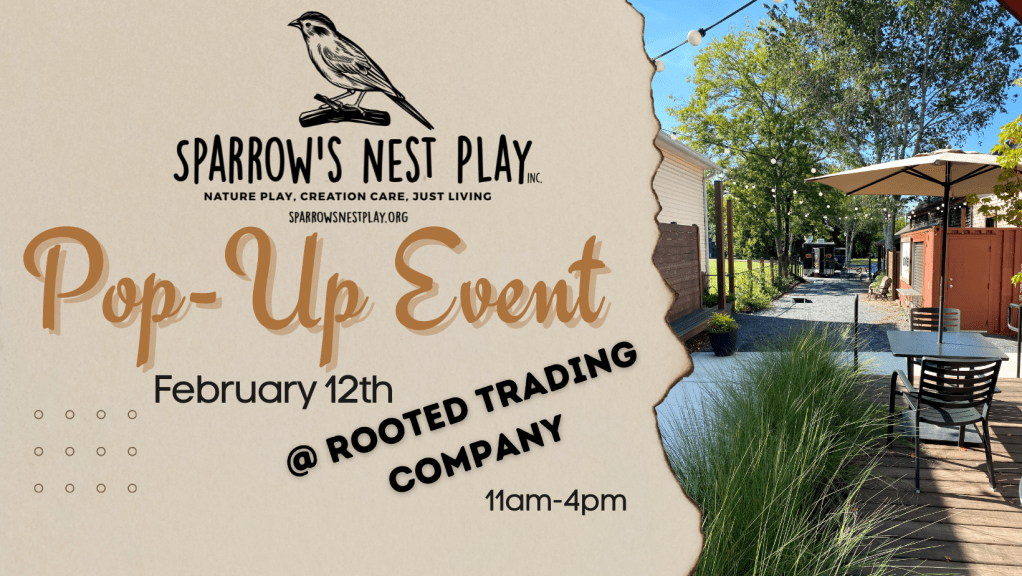
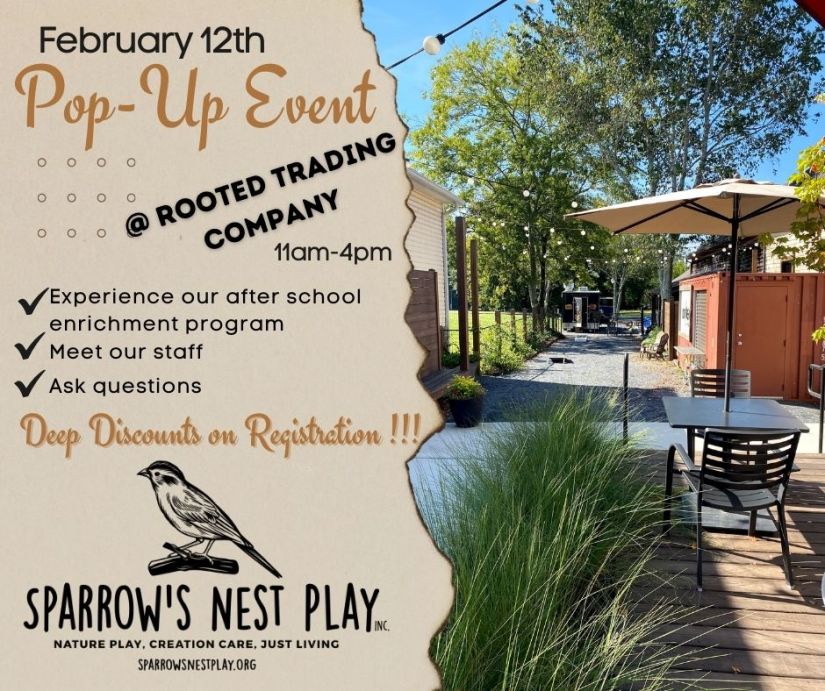
We’re thrilled to be partnering with our friends at Rooted Trading Company for our very first Pop-Up Event on Saturday, February 12th from 11am to 4pm. Our goal is to recreate a mini Sparrow’s Nest Play experience so families can learn about us and try us out before making a commitment to our afternoon enrichment program, Nature Play Adventures, beginning in March at Powder Springs Park. Here is what you can look forward to…
For Parents:
This is a great chance to meet our staff and ask questions about our program.
Watch your children interact with our staff and the kind of play we practice each day.
Pick up articles and information about the benefits of nature play and time spent outdoors for children.
Cash in on discounts on our annual Registration Fee!
For Kids:
Play in our fort with our “campfire,” small world play, and other nature toys.
Enjoy looking through our books about nature and the great outdoors.
Make a fun nature craft to take home while making new friends!
Similar events are also planned for March and April, so if you don’t catch us in February you can watch our Facebook and Instgram for announcements about upcoming events.
We are more than a little excited to be gearing up for our Nature Play Adventures program which will begin in January at Powder Springs Park. Here is a short preview of what our forest friends will be discovering through play and projects…
Birds in Winter
A fun part of getting to know “our forest” will be cataloging the birds that we observe there. We’ll begin identifying birds by sight and even by call for our running list of birds that live there. We’ll learn about their ideal habitats, as well as that they eat during the winter months. On our project list will be bird feeders – both for home and for “our forest.”
Winter Tree Study
We’ll also get to know our native plants and trees by mapping our forest. It’ll be a little tougher without the leaves to help us identify them, but it’ll be a lot of fun to see if our deductions based on bark and other observations were correct in the Spring when leaves come out! We’ll take some sticks and twigs from our favorites and do some nature weaving this week.
The Winter Sky
Noticing the signs of the seasons will become a daily part of our rhythm, so we’ll begin by taking note of times of sunrise and sunset each day. We’ll review each season’s solstice or eqinox and learn how this affects the length of our days and temperatures. Noting the small changes each day will sharpen our observation skills immeasurably. As we notice that we often have “wet” winters here in our region, we’ll make a rain gauge for our base camp.
The Moon
Building on our knowledge of weather and seasons, we’ll discuss the phases of the moon. We’ll research the Farmer’s Almanac for moon phases and learn about special moons like “Harvest” and “Blue” moons. We’ll be sure to have lots of books on hand about the moon and it’s phases.
Add to all of this a dash of Outdoor Safety Skills and the splash of ongoing fun that will be getting acquainted with “our forest” and you’ve got a recipe for adventure. Tell a friend about our program while there are still spots available! To register today go to our Registration Page.
I’ve spent much time during the last few years bemoaning “used to be” and what we don’t have. I have grieved for the political system we haven’t had, the compassion unspent and the justice unseen. It has been a topic of constant conversation in my home and with my loved ones. We have kept our eyes on the horizon longing for a sign of hope.
Through it all, I’ve lived in the same place – the same physical location. My son finished high school and began college here in this smallish suburb of metro Atlanta. It has a rich history with which I am still acquainting myself. While tensions ran high across our country and diversity seemed to bring tension and strife in many communities, our little town just “kept on.” For the most part, white, black, and brown folk continued to wave and say “How you ta’day” when they met in the local Mexican restaurant. We don’t know one another by name, but we’re familiar enough to know where we know one another from.
Jason and I like that about our town. We like that the diversity is something that is a part of being where we are physically located in our county and state. It is in harmony with our values, and with who we wanted our children to be when they became adults and had families of their own. We aren’t naive enough to think it always works out perfectly in our community, but we do sense an intentionality here. Our love of this place is one of the reasons we’ve chosen to invest our hearts here in the name of Sparrow’s Nest Play.
The past is our definition. We may strive with good reason to escape it, or to escape what is bad in it. But we will escape it only by adding something better to it.
Wendell Berry
Born of privilege, we realize we’ve had opportunities others have not enjoyed. The realization of those inequities has made it impossible for us to continue on as if we never knew about all people on the margins. Our identification with the autistic community and those who identify as “neuro-diverse” have awarded us opportunities to experience some of those margins ourselves.
COVID has only highlighted areas of drastic inequality. When many schools went to virtual learning, it wasn’t an issue for areas with wifi access or families with technology to support that kind of learning. For others, it was impossible. Some families saw this as an excellent opportunity to try out forest schooling and nature play as alternatives. However, these programs are often expensive and comparable to private school options. For families of lower income, this was not an option.
We realize many parents in our community are working extremely hard to provide for their children. This can often mean working a job and a half, which means utilizing an after school care program to assist with childcare. Sure they’d love to pick up their children right after school and let them go home and play outside in the fresh air, but that option is simply not open to them. For those families, the school after care program is the most cost-effective option, even if it does mean three additional hours each day inside a crowded school cafeteria.
Sparrow’s Nest Play wants to partner with families in our community to change the way children spend their afternoons. Using our town as an educational hub, we want to immerse our kids in nature and creation care every afternoon, engaging them in projects that will enrich their minds and build relationships.
Through a partnership with Rooted Trading Company and the City of Powder Springs, we will be bringing our Nature Play Adventures Program in Spring 2022. We’ll be starting small, with only room for 6 students – but we’ve always believed that it is the smallest of things that really make a difference.
Please consider helping us in our endeavor by sponsoring this program so that we can make it a cost friendly option for families in our community.
Violence against our world and our fellow beings finally cannot be dissociated from the violence of falsehood.
Wendell Berry, On Receiving one of the Dayton Literary Peace Prizes, Our Only World
I’m hardly ever consciously trying to be controversial. Usually, I just mildly annoy people with “my passion” for whatever it is I am speaking into. But occasionally, I really set someone’s teeth on edge by becoming what they might call “political” about a topic. As I’ve written in another blog on Nature and Spirituality, I’m an equal opportunity offender – irritating both the Conservative Right and the Liberal Left. It once bothered me greatly and I would loose sleep at night. Now I sleep just fine.
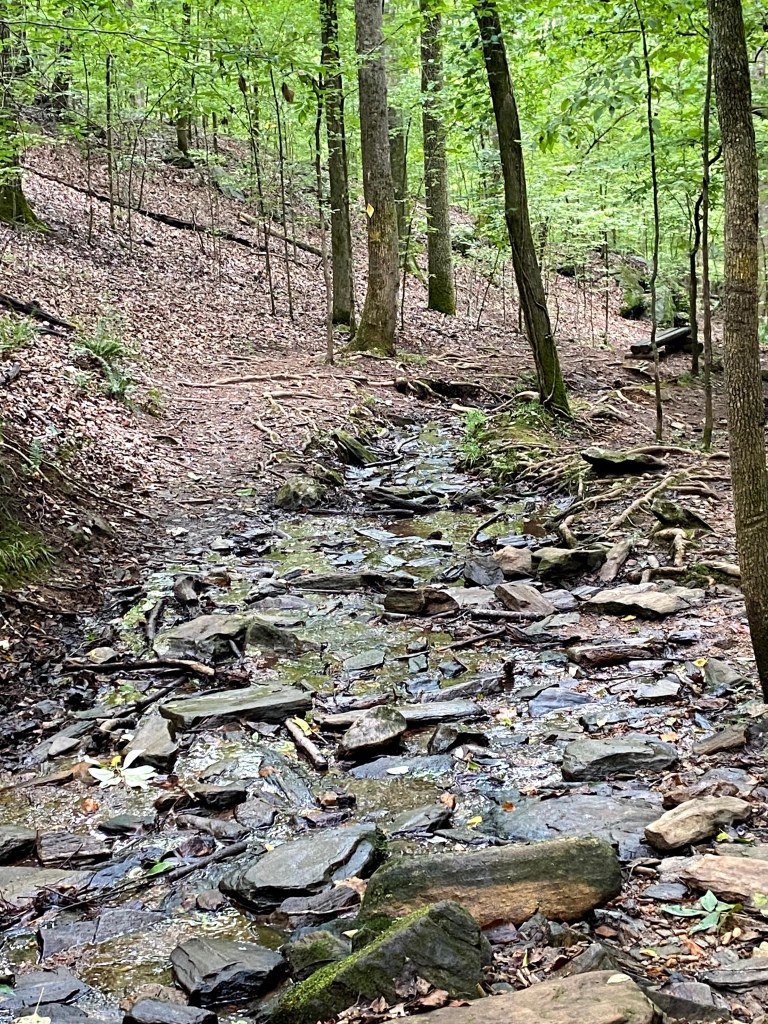
creek bed along trail
I preface this post with these thoughts because I know my recent research into environmental justice has made (at least) one of you uncomfortable. I can hear you saying, “Why does she have to go there? Can’t she just do her nature play outdoorsy thing and leave well enough alone? None of this really has anything to do with loving and sharing the world God made – that is Creation Care! Leave the justice issues out of it.”
The problem is that leaving justice out of it is falsehood. It is a lie of omission. Omitting the facts about our history of environmental injustices allows us to anesthetize ourselves not only to our past, but also to present and future dangers that share the lives of those we would call “brothers and sisters.”
We must act daily as critics of history so as to prevent, so far as we can, the evils of yesterday from infecting today.
Wendell Berry, On Being Asked for ‘A Narrative for the Future,’ Our Only World
While hiking at a state park just minutes from my home this weekend, I was thrilled to see many black and brown faces on the secluded trail we chose. I met so many diverse people on the trail that as I journeyed, I wondered if the issues surrounding environmental justice might have not already been solved. Maybe these issues really aren’t worth noting and writing about any more?
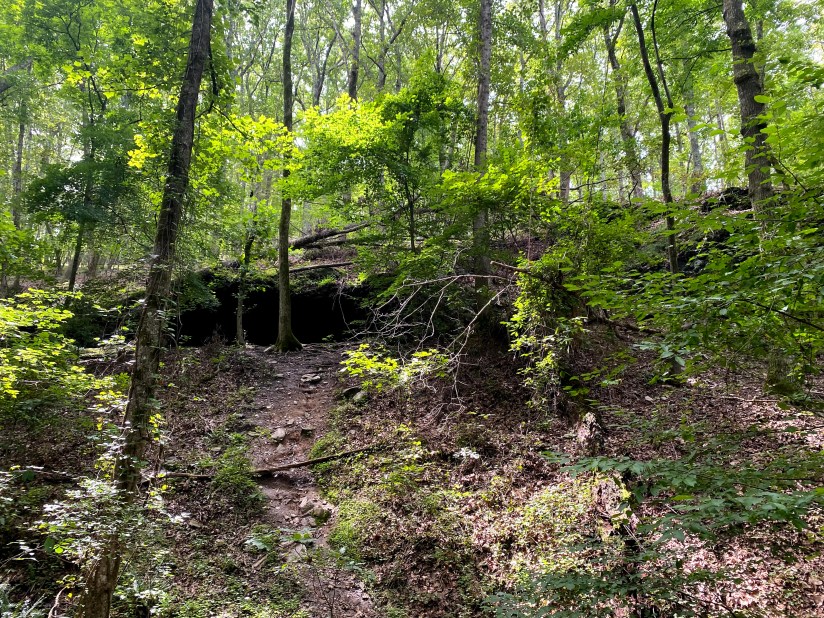
Suddenly as the trail descended, we were met by a large rock outcropping that I remembered reading had been studied by archeologists as a site of shelter used by Native Americans for several thousand years. I didn’t see any of them on the trail, however, because we relocated the Cherokee from this region a long time ago. And I was reminded that we are all susceptible to the violence of falsehood out of a desperation for a sense of well-being.
rock outcropping used by Native Americans
The hidden truth is, recognizing and acknowledging matters of environmental – or any other kind of – justice will not exclude us from appreciating, enjoying and sharing the good and beauty of a place. The two ideas are not mutually exclusive. The joy of being appreciative for a place cannot be disassociated from understanding the history of that place. And understanding the wrongs that have occurred don’t change the way I can appreciate the spicy smell of a hardwood forest.
To fail to enjoy the good things that are enjoyable is impoverishing and ungrateful.
Wendell Berry, On Being Asked for ‘A Narrative for the Future,’ Our Only World
So I will hold both the beauty and the conflict in each hand, allowing myself to always know the tension between what terrible things have happened, so as to more fully know the burning desire to share this beauty now with all peoples. Any other way of pretending is falsehood and violence. It would not be peacemaking.
We’ve recently posted a series of articles about the Physical, Social-Emotional, and Cognitive benefits of exposure to nature. Without listing them all again, there is research-based evidence to support:
Extended time playing in nature creates the minds business leaders call “21st Century Leaders” – creative thinkers, innovators, problem solvers and collaborators
Nature play promotes healthy bodies during a time in our history when childhood obesity is at an all time high
Place-based learning and care for the natural world create learners who are adaptable, compassionate and interconnected to their community
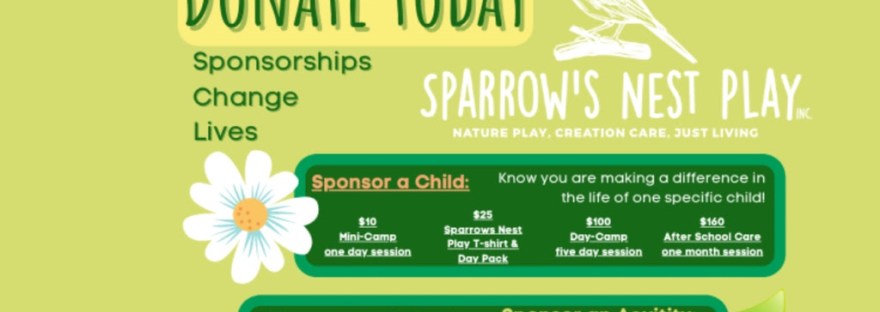
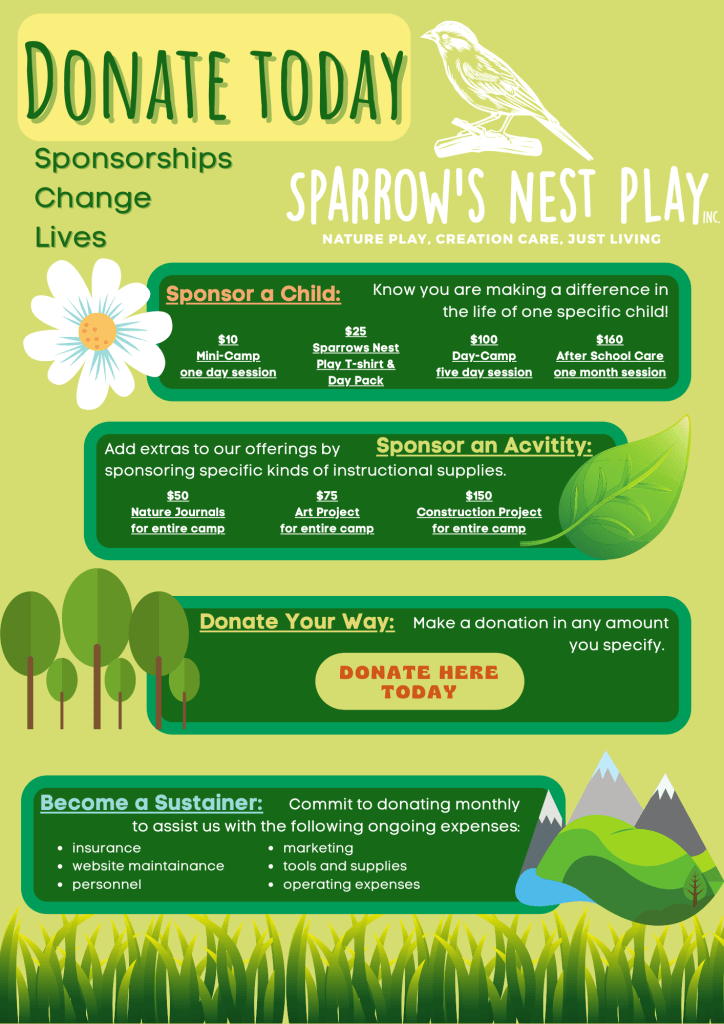
At Sparrow’s Nest Play, we are in the process of putting together our VERY FIRST DAY of Mini-Camp. This day of learning will expose children to nature play through crafts, den building, tracking, nature journaling, and outdoor safety lessons. But we need funding to help get things started. Listed below are some of the ways your donations will add to the experience for a child at a day of Mini-Camp.
Please consider introducing a child to the wonders of creation by sponsoring a child or activity. Donations of any amount help us further our mission at Sparrow’s Nest Play.
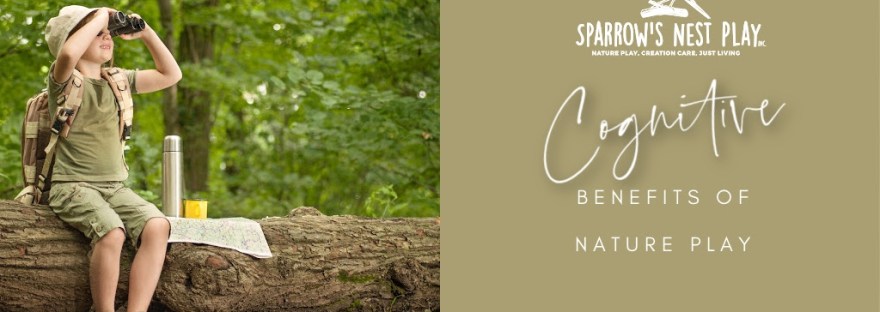
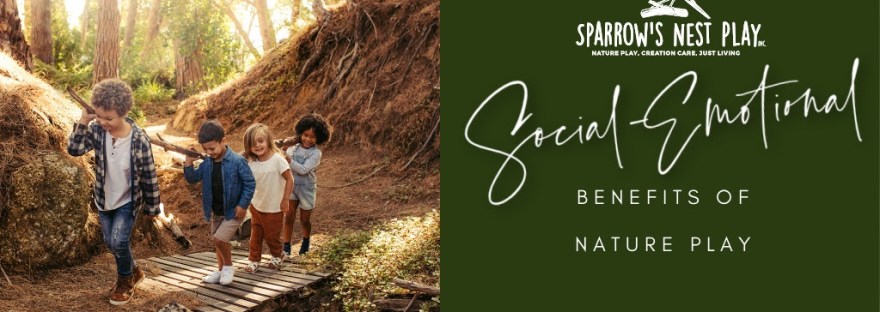
The benefits of nature play have been known for many years, but more recently evidence-based research is documenting groups of children that have matriculated through early childhood programs and are able to display the real benefits daily exposure to nature contributed to their physical, cognitive and social-emotional development. See notes at the end of this article for links to research confirming our passion for keeping outdoor play a part of the daily life of children.
Problem solving & Critical Thinking: The child-led method of forest schools and nature play in general promotes independent thinking as children create their own projects, encounter problems within their designs, and then use critical thinking to resolve the design to make it efficient. This process occurs multiple times an hour during a typical day, allowing those neural pathways plenty of practice to strengthen as they develop.
Creative & Divergent Thinking: So many classroom-based projects are close-ended, not by design, but by the practical limitations of the physical environment. When the natural world is your classroom, there is enough space to think not only “outside-the-box” but outside-the-walls. Ideas that might have been seen as divergent (even impossible) within a traditional setting now become serendipitous.
Increased Knowledge Base: If you are thinking, “but they’ll only learn about nature…” please stop and realize that by observing nature we can learn the following disciplines: aeronautics, agriculture, arithmetic, art, astronomy, biology, chemistry, economics, engineering, geography, history, physics, and so many more.
Communication Skills: As all of these benefits are exercised over and over again in the course of just one hour in nature play, children are communicating their thoughts, ideas, and even disputes with one another. They learn to debate the merits of one course of action over another, and then to perhaps negate that hypothesis and return to they drawing board as a collective. Civil discourse is still alive in nature play and the forest school environment!
Special thanks to Jean Lomino at the Forest Teacher Institute whose contributed to the resourcing and development of this article.
At Sparrow’s Nest Play, our tag line is Nature Play – Creation Care – Just Living. That last one highlights our focus on justice related issues as they relate to the natural world and its resources. I’ve had the honor of meeting a ton of like-minded people this summer as I’ve completed my Forest School Teacher and Director Training. This training led me to delve into researching programs across the nation, while meeting other nature play leaders from, literally, across the globe.
My research quickly led me to fully realize some great disparities that I’d been ducking and dodging for several years – unsure if they were “real issues,” or just something I was picking apart needlessly. As it happens, those issues are indeed real. They have names and movements and research to which I had never been exposed.
The clues that had frustrated me for years should have been enough to send me on this search years ago. Here are a few of them I experienced daily when I lived near the edge of southwest Atlanta, where I grew up:
Our public parks, of which there were few, were run down and full of broken equipment with peeling paint. Most were devoid of grass and sparsely planted with trees. It was never a very relaxing or restorative place to take my small child for the afternoon.
Each of the grocery stores in town was small, dirty, poorly stocked and had poor quality fruits and vegetables. I didn’t know “organic food markets” existed until I moved into a wealthier and whiter zip code.
Even on our own street, it didn’t always feel safe for my child to play in our backyard – inside our 6 foot fence with our large dog. It wasn’t unusual to hear loud explosions and not be confident if it was a car backfiring or a gun shot. The police department was chronically underfunded, we were told.
When the wind blew from a certain direction you could smell the chemical plant – a sickly, sweet smell that left the inside of your mouth tasting like you’d been sucking on a penny. It wasn’t out-of-the-ordinary for a boil water notice to be issued without explanation. One night we were even evacuated to a church on the other side of town due to a chemical leak.
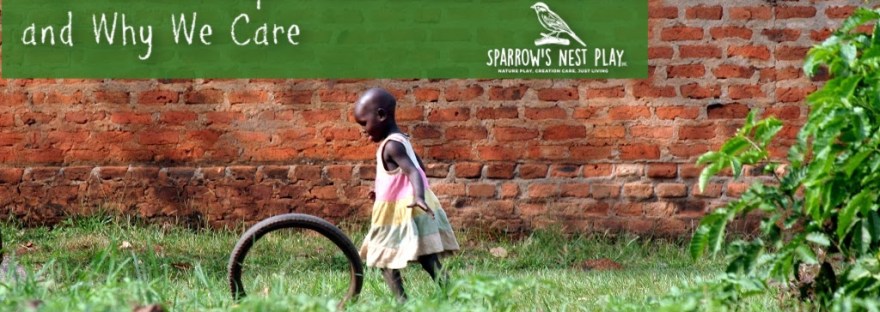
At the time, I reasoned that the neighborhood was just “run down” and due to complete survival fatigue, many of the residents just couldn’t summon up the initiative to change things. What I didn’t realize is that I was living in The Nature Gap – a very real place, duplicated in cities around our nation.
In the midst of accumulating and ingesting the facts about the disparities in equitable access to nature between wealthier, white populations and those of color, I was also given an assignment to research and cultivate my own philosophy by comparing them with that of Montessori, Reggio Emilia, and Waldorf. While I will spare you the majority of my paper on the three philosophies, I do want the world to know where the study led me personally.
As I reviewed each philosophy, I found great merit within every one. However, studying the culture and time of each founding philosopher, one may also intuit how their belief system was in many ways a reaction to the societal norms, or even upheaval, of their time in history. In much the same way, I must acknowledge that the culture and philosophy of Sparrow’s Nest Play is a reaction to the trends I see in today’s American society.
So it must be said that I live in a world where:
it is widely accepted thatchildren are more vulnerable than adults to the negative effects of environmental toxins because of the fundamental differences in children’s physiology, metabolism, absorption, and exposure patterns that cause children’s bodies to react to and excrete toxins differently than adults
increasing evidence suggests that access to nature and green space provides children with a myriad cognitive, emotional, and physical benefits, such as increased ability to concentrate, improved academic performance, reduced stress and aggression levels, and reduced risk of obesity
Unprecedented numbers of children in the United States suffer from asthma, cancer, low IQs, and learning disabilities each year
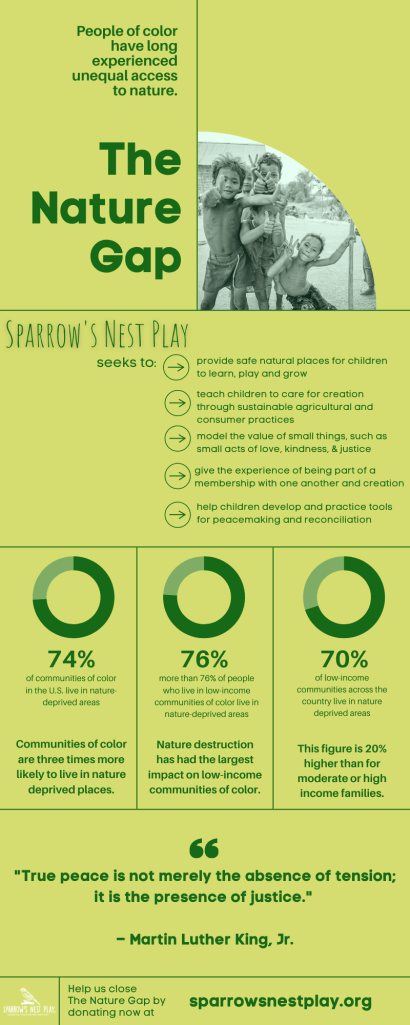
Communities of color are almost three times more likely than white communities to live in “nature deprived” areas, those that have less or no access to parks, paths, and green spaces.
Discrimination and racism in the United States have had profound effects on human settlement patterns and on the patterns of protections for the nation’s remaining natural areas. Redlining, forced migration, and economic segregation are just a few of the unjust policies and forces that have created barriers to, and a gradient of distance from, the United States’ remaining natural areas for people of color
Communities of color are three times more likely than white communities to live nature deprived places. Seventy-four percent of communities of color in the contiguous United States live in nature-deprived areas, compared with just 23 percent of white communities.
Seventy percent of low-income communities across the country live in nature-deprived areas. This figure is 20 percent higher than the figure for those with moderate or high incomes.
Nature destruction has had the largest impact on low-income communities of color. More than 76 percent of people who live in low-income communities of color live in nature-deprived places.
Sparrows Nest Play must be a place where children, regardless of ability, race or socioeconomic background…
1. Have a safe place to learn and grow.
2. Learn to care for creation through sustainable agricultural and consumer practices.
3. Learn the value of small things, such as small acts of love, kindness, and justice.
4. Experience being part of a membership with one another and with creation.
5. Develop and practice tools for peacemaking and reconciliation.
I’m sure we can utilize methods from all three popular philosophies to do this, but we’ll also love our neighbor as ourselves, while we are serving and preserving the world we’ve been given. And all will be welcome, but we just can’t ignore the gaps any longer.
Looking for a small way to show your support of Sparrow’s Nest Play in a tangible way? Well, buy us a book and you’ll be showing us how much you loved and supported this cause forever!
Education is a big part of what we hope to do at a session of Day Camp or our After School Program. Sometimes a well-written book to read aloud is the best springboard for community discussion and activity starters. We cover a lot of ground at Sparrow’s Nest Play. Some of our topics include:
Creation Care
Sustainable Agriculture
Responsible Consumer Practices
Acts of Love, Kindness, Mercy and Justice
Friendship and Community
Peacemaking and Reconciliation
the teachings of Jesus
It is our hope to have quite a library of literature for children and parents to access. If you know of a book resource you’d like to donate to “the nest,” we’d love to add it to our collection. Or you can help start our collection by checking out our Thriftbooks Wish List.
The small act of buying one of these resources can set a child’s imagination free to explore the world through a renewed sense of wonder. Please consider partnering with Sparrow’s Nest Play today as we play in nature, care for creation and teach just living.
The benefits of nature play have been known for many years, but more recently evidence-based research is documenting groups of children that have matriculated through early childhood programs and are able to display the real benefits daily exposure to nature contributed to their physical, cognitive and social-emotional development. See notes at the end of this article for links to research confirming our passion for keeping outdoor play a part of the daily life of children.
Independence: One of the most important tenants of forest school and nature play is child initiated instruction. This is sometimes also referred to as child centered learning or child directed learning. Unlike the traditional classroom setting where a teacher decides the lessons and goals for the day, the children are not passively receiving information. Instead, lessons are based on their encounters with nature and the interests that develop from those encounters. This alone, fosters a spirit of independence, question asking, and innovation.
Respect and Compassion: It is not unusual for nature play environments to include multi-age groupings. In this way, older children are compelled to assist younger children as they remember the near past when they learned whatever skill with which a younger friend might struggle. Younger children are able to see the differences in physical, cognitive, and other kinds of development (even if they can’t name them) between them and the older children and learn respect, looking forward to learning these skills. This “give and take” among the children creates a peaceful environment where collaboration instead of competition is the rule of the day.
Resilience & Perseverance: One inevitable side-effect of child directed learning is the use of the scientific method in problem solving. Of course, rarely are we 100% correct on our very first trial. This healthy perspective of trial and error builds a reliance missing in the educational processes found in many traditional classroom settings.
Self-confidence: The fertile soil of resilience is a wonder place for self-confidence to flourish. If trying and not accomplishing your goal isn’t really “failing,” then the possibilities for how we feel about ourselves are endless. Think of the important question: What would you do if you knew you could not fail? In this instance, there is no failure daily in the nature play or forest school experience.
Sound judgement: As children make decisions and learn the value of taking calculated risks (see Risk Taking below) they develop a sense of sound judgement about their own abilities and boundaries. Climbing a tree and testing branches involves taking risks. Assessing which branches will hold you and which aren’t sturdy enough to bear your weight require the development of sound judgement.
Cooperation: Building forts, recreating “Bug Hotels,” damning creeks, and many other projects children undertake during the course of nature play foster collaboration and cooperation. Children learn the give and take of ideas and solutions for problems. As they grow closer in community and learn that everyone is heard and all ideas are valued, they realize that even if their strategy isn’t used in a particular situation, there will be other opportunities.
Leadership: Because children create many of their own projects, they are often source of leadership for them as well. Opportunities to learn how to lead abound daily. Adults serve as guides and resources, not the leaders – making room for the children to learn this important skill.
Adaptability: If children aren’t learning adaptability through project-based learning, they certainly are observing it through the lessons of nature. Studying animals that have adapted through camouflage or migration reminds them that living things must learn to observe the world around them and watch for the need to make changes. In nature, the inability to do so often leads to life and death consequences – for humanity, it leads to frustration.
Risk Taking: Not enough can be said about the need for children to be exposed to opportunities for decision making and risk taking. Not scary, haphazard, dangerous risks that put them in harm’s way, but calculated choices that lead to discovery. Because the primary method of instruction and guidance (we don’t even like to call ourselves “teachers”) in forest school and nature play is open-ended questioning, children are allowed to explore their own conclusions and ideas without fear of failure or being wrong. This leads to innovation, creativity, self-confidence and is, I think, the key building block for healthy self-image.
Special thanks to Jean Lomino at the Forest Teacher Institute whose training contributed to the resourcing and development of this article.
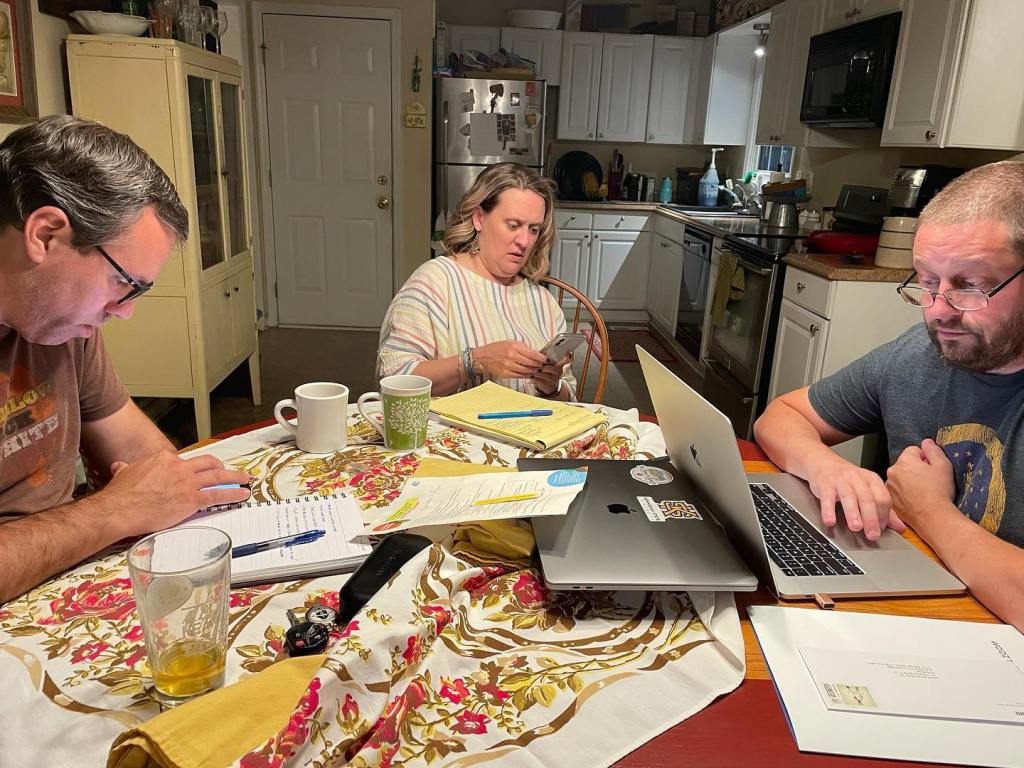
A few weeks ago, I sat at my kitchen table with dear friends who have agreed to form my first board at Sparrow’s Nest Play and made a confession. I told them that as passionate as I was about nature play, creation care and just living, I didn’t have a clue what a session with children would actually look like. I had a bunch of disconnected thoughts, but no real cohesive plan for how to fit my philosophy into a construct that included daily schedules and a curriculum framework. While I wasn’t discouraged, I’d be dishonest if I didn’t say that it set off a bit of “imposter syndrome” for me, and I felt discouraged.
Forest Teacher Training from the Forest Teacher Training Institute has completely changed those feelings for me. I have left this 30 hour certification with everything I knew I was missing and so much more! If you are at all interested in the forest school movement – even if you are not sure where your passion might take you – I encourage you to investigate this course of study. Here is just a taste of what I have taken with me…
Community is at the heart of the nature play and forest school movement. I have spent many frustrated years in the “for profit” markets where all resources (access to philosophies, curriculum, and even people) were commodities to be purchased. I’ve always resisted this in favor of an approach that was based on sharing for the good of the greater community. Not only does the forest school movement generally reflect this spirit, the daily practices share the value of honoring the community of learners. (See my post on Kinship from my Forest Teacher Training Diary series.)
Daily Rhythms and Rituals have now replaced the space in my mind once occupied by the dreaded “Master Schedule.” After studying FLOW Learning, as well as the Waldorf philosophy of “inhale/exhale,” I have a totally different approach to organizing learning activities. The variety of ideas I have been exposed to helped me to create sample schedules for everything from a One-Hour Session for a learning center or daycare, to a Full-Day Session for a day of camp. I’ll be making my Teacher Training Portfolio available soon so you can see how Sparrow’s Nest Play will approach learning together.
Before my training, I was somewhat at loose ends when I considered how to approach curriculum. As non-commercialized as the forest school movement is, you can still find those willing to sell you complete curriculum with scope and sequence for your group. I was unsure if this was how I “had” to approach it. I learned that becoming co-learners with the children means that I will have the liberty to let the children show me their interests and build from there. Of course, this means having about 20 or so curriculum units “pre-planned” and organized seasonally so you can be prepared to capitalize on an encounter with nature. But the freedom this brought me immediately took so much stress from my lens of what curriculum had to be that I was immediately able to create a Seasonal Curriculum Framework. It will also be included in my portfolio.
And the delicate, random and fear-producing questions I had answered are just too numerous for me to write about, but here are a few:
It is okay to have multi-age groups?
Can I incorporate sustainable living and justice issues?
Can animals be a part of a nature play environment?
Will I really be able to keep the kids safe?
Are there ways to envelope families into the forest experience?
Can I do “forest school” in an urban area?
Will the ideas from forest school work if I want to start with an after school program?
Do I really know enough if I’m not a naturalist?
The answer to all of these lingering questions was “Yes!” Now my enthusiasm is brimming over and waking me up at all hours of the night.
I’m also humbled to say that I’ll be able to continue my certification to earn my Forest Director Certificate because of a generous scholarship. I am beyond thrilled to extend my learning to include topics like Site Development & Risk Evaluation, Developing Forest School Culture and Identity, Staff Development and Program Assessment, Marketing and Proposal Development, and a seminar in the Global Forest School Movement. The end product of this certification will be my own formal Proposal Presentation for Sparrow’s Nest Play.
For all of you who are following our journey at Sparrow’s Nest Play, I appreciate your comments and all the ways you are encouraging me to put forth the ideas of creation care, nature play and just living into the world. Please continue to follow our blog, as well as our social media on Facebook and Instagram to see where our journey takes us next.






 Sparrow's Nest Play, INC.